In 2015 I took a Canon 5DsR to Bunaken and Lembeh to find out what fifty megapixels does underwater. The answer was not what I expected, and the lesson has outlived the camera by a decade — because every high-resolution body since has made the same trade.
Diffraction arrives much earlier
This is the finding that matters. Macro work pushes you to small apertures because that is how you hold a whole subject in focus at life size. On the 5D Mark III I could generally get to f/25 before softness became intolerable. On the 5DsR the images started going soft at f/11.
That is not a fault in the camera. The diffraction-limited aperture is a property of pixel pitch: 6.7 on the 5DsR against 10.1 on the Mark III. Pack more photosites into the same full-frame sensor and the point at which diffraction becomes visible at the pixel level moves towards wider apertures. More resolution, less usable aperture range. You cannot have both.
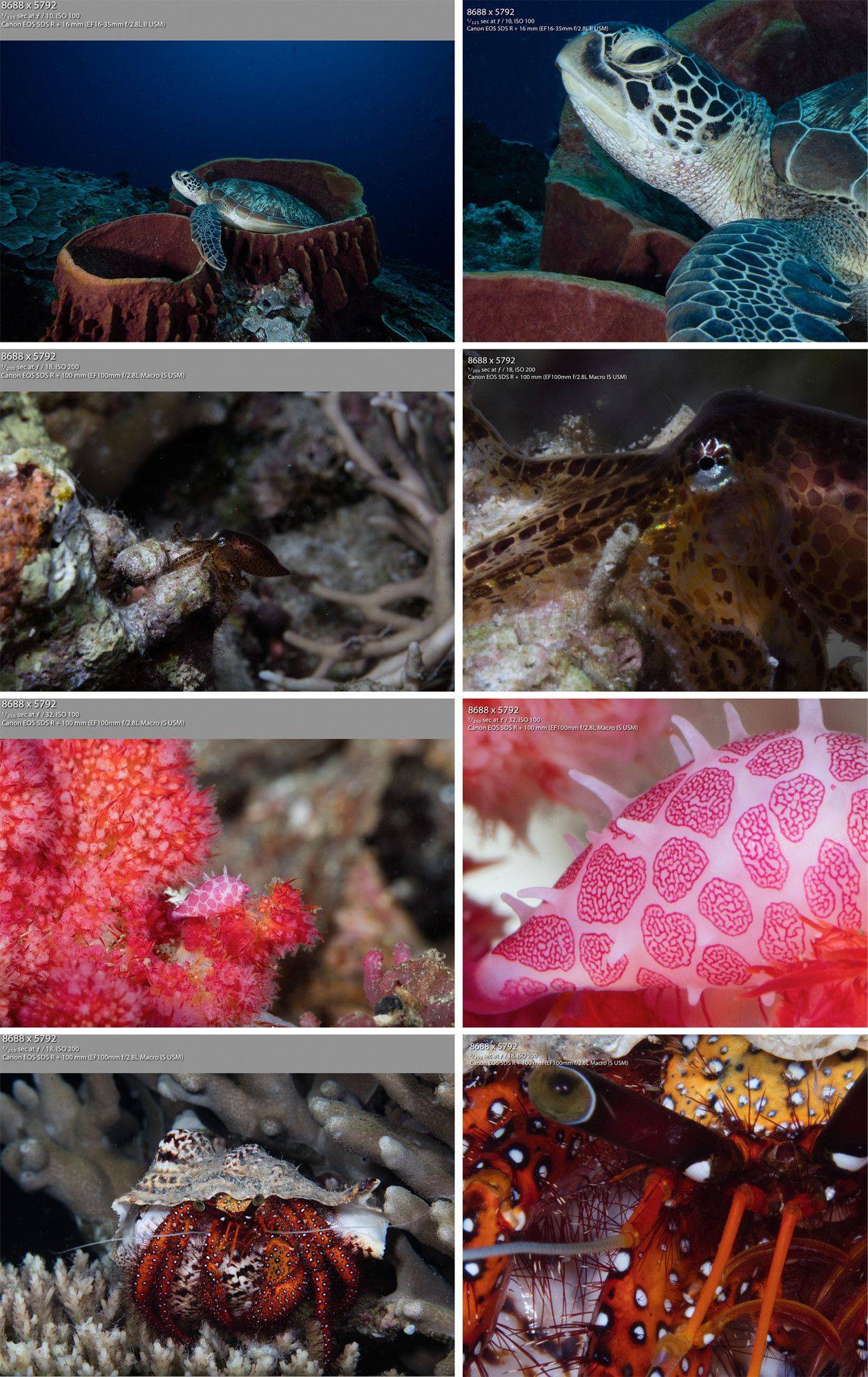
What that means in the water
You stop reaching for the aperture ring and start solving focus a different way. Get closer. Put a wet dioptre or a doubler in front of the port instead of stopping down another two stops. Light harder so you can afford to open up. Compose so the plane of focus does the work rather than depth of field rescuing it.
It also punishes technique. A number of frames I was certain I had nailed turned out to be fractionally off once I saw them at full size — the sensor resolves your focus errors as readily as it resolves the subject. When you do nail it, the file takes a heavy crop and still holds, which is the compensation.
The smaller findings, which still hold
What I tested with
Aquatica housing, twin Sea & Sea strobes, two focus lights, carbon-fibre float arms, a doubler, and the Canon 100mm macro. Full manual throughout, focusing with a port knob rather than letting the camera hunt.

Why a decade-old test still applies
I shoot a Canon R5 Mark II now. It is a different camera in almost every respect, and the trade at the centre of this piece has not moved: high pixel density buys you detail and cropping room, and charges you for it in usable aperture and in tolerance for sloppy focus. If you are choosing a body to put in a housing, that is the question to ask about it — not how many megapixels, but where the softness starts.